Future-proof portfolio
Eastnine’s property portfolio is characterised by high technical standards and has been consistently adapted to meet climate and energy-related requirements. This has resulted in a portfolio with top rankings in environmental certification and external assessments based on established frameworks in the real estate sector, such as the Global Real Estate Sustainability Benchmark (GRESB), as well as established operating practices for achieving energy-efficient and climate-resilient operations.
Eastnine works with key sustainability areas to ensure that the Company continuously manages and steers its property operations to meet technical, environmental and workplace standards also in the future.
Sustainability-certified portfolio
100 per cent of the properties in Eastnine’s portfolio are certified according to internationally established environmental and health-related certification systems.
The certifications cover climate and energy performance, as well as aspects related to the health, safety and well-being of a building’s users. They also constitute a key tool for quality assurance and long-term value protection of the property portfolio.
100%
Sustainability-certified property portfolio
Net-zero greenhouse gas emissions by 2040
SBTi-aligned climate targets
Eastnine’s climate targets are fully aligned with the Science Based Targets initiative (SBTi) and are based on a 1.5°C scenario.
Drivers for emission reductions 2025–2030
Through energy efficiency improvements and conversion of heating systems, Eastnine strives to reduce the emission intensity of its operations in line with its climate targets.
- Energy optimisation – achieving a 25 per cent improvement in energy intensity across the property portfolio from 2025 to 2030 through technical measures and systematic operational improvements.
- Fossil-free district heating – gradual transition to more sustainable district heating sources, aligned with suppliers’ transition plans.
- Heat pumps in Poland – installation of heat pumps to reduce dependence on fossil-based district heating where green alternatives are not yet available.
Target scenario
Net-zero greenhouse gas emissions by 2040, in accordance with the SBTi Net Zero Standard.
Reduce emissions by at least 50 per cent by 2030 compared with the 2024 base year.
Covers emissions in Scope 1, 2 and 3.
Applies to all material emission sources across the entire value chain.
Energy performance and climate
Energy efficiency and renewable energy are key issues for Eastnine. The real estate and construction sectors account for approximately 30 per cent of global energy consumption and are a significant source of carbon emissions. Therefore, reducing energy consumption is not only about achieving cost savings; it is a vital step in decreasing emissions, aligning with the Paris Agreement and thereby contributing to a more sustainable real estate sector.
Energy performance and climate impact are key factors for assessing the quality, resilience, and long-term value of the property portfolio.
Energy in the investment and property management process
Energy efficiency is integrated early in the investment process. As part of due diligence, the energy performance, technical systems and long-term improvement potential of the properties are assessed, often in collaboration with external advisors and technical specialists. Following an acquisition, the property is incorporated into Eastnine’s standard framework for energy monitoring and technical operations.
Data-driven monitoring and technical measures
Through continuous monitoring of data, operational patterns are being analysed over time, and measures based on actual usage and performance can be implemented. Energy initiatives encompass operational optimisation and technical investments tailored to each property’s specific conditions.
Recurring measures include:
-
Optimisation of control and regulation functions in heating, ventilation and cooling systems.
-
Installation of energy-efficient solutions, such as heat pumps.
-
Transition to LED lighting, along with the use of sensors and demand-controlled operations.
-
Incorporating insights from environmental and energy certifications into day-to-day management.
Energy efficiency and outcomes
-
Digital energy management systems are used for continuous monitoring across the portfolio.
-
Technical measures have been implemented to improve the energy performance of the properties.
-
In 2025, energy consumption decreased by approximately 25 per cent compared with 2019.
Climate performance and outcomes
-
All properties are supplied with 100 per cent renewable electricity.
-
Fossil fuels for direct heating were phased out in 2025.
-
Emissions intensity in 2025: 9.3 kg CO₂e/sq.m.
(2024: 9.4). −55 per cent reduction on a like-for-like basis. -
SBTi-aligned climate targets were established in 2025, with a target of at least a 50 per cent reduction in greenhouse gas emissions by 2030 and net-zero emissions by 2040.

Read about how Eastnine reduced energy consumption by 35% in the property Nowy Rynek D in Poznan after the acquisition.
Limiting physical risks
Climate risks and climate adaptation
Climate-related risks are an integral part of Eastnine’s risk management and are systematically analysed at the property level. The aim is to identify physical climate risks that could impact the function, value and long-term operational reliability of the properties, and to ensure compliance with the EU Taxonomy’s climate adaptation requirements.
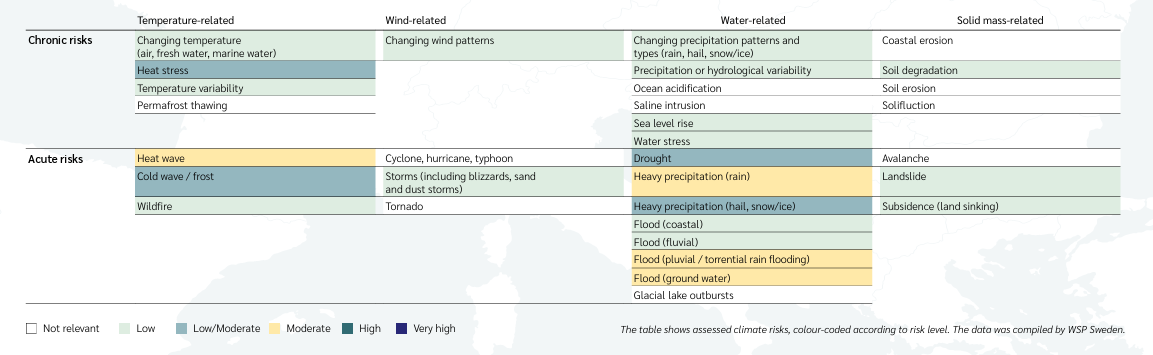
In 2025, all Eastnine's properties were analysed by external experts in accordance with EU Taxonomy guidelines for physical climate risks. The assessment combined each property’s exposure and vulnerability, carried out in line with established international standards and using climate data based on a worst-case scenario (RCP 8.5).
The table presents the highest identified risk level within the portfolio for each physical climate risk. Eastnine’s property portfolio is concentrated in Northern and Central Europe, where physical climate risks are generally considered manageable. For most risk categories within Eastnine’s portfolio, the risk level is assessed as low to moderate.
The most prominent risks relate to heat and heat stress, as well as heavy precipitation and pluvial flooding, consistent with the portfolio’s geographical exposure.